The problem
A state education agency sets priorities for every district it oversees, then has to see those priorities carried out and make sense of what districts report back. Students First is sold directly to state agencies to do that work. North Dakota was the first.
Before Students First, there was no real way for a state school board to track how a statewide goal was being implemented across all of its districts. Priorities were set at the top, passed down in meetings, and trusted to be carried out. Whether that happened, and whether it made any difference, was hard to see from the state, and just as hard for a district to show.
Students First makes it measurable. The state can follow every district’s progress on each priority and see the effect of the plan, and districts can show that they’re carrying it out. Both sides get confidence that the plan is being implemented and that it’s working.
From a priority to a plan
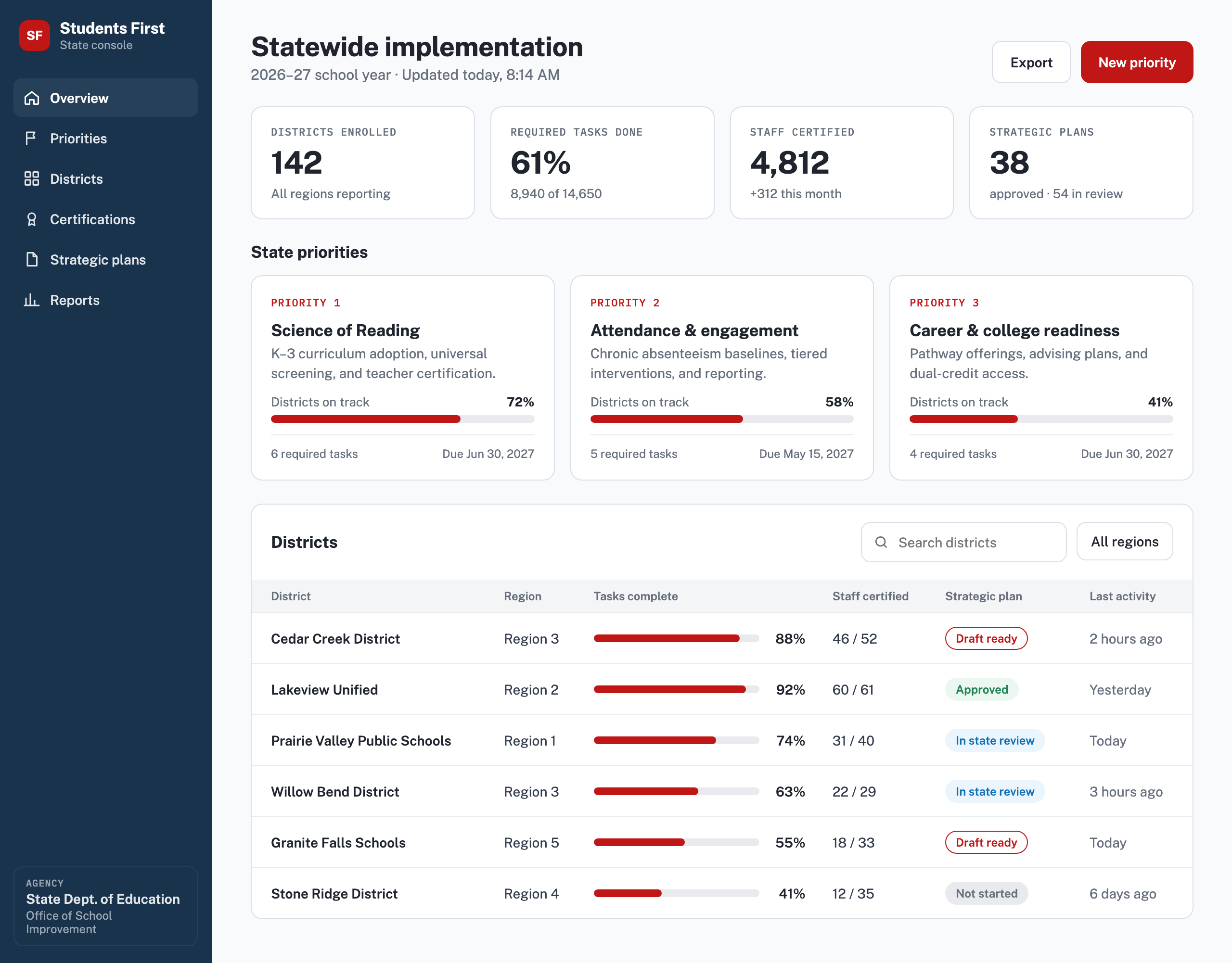
The state starts by setting its priorities for the year, like the Science of Reading or attendance, and breaking each one into the tasks, evidence and staff certifications it expects from every district. From then on, it can see where every district stands.
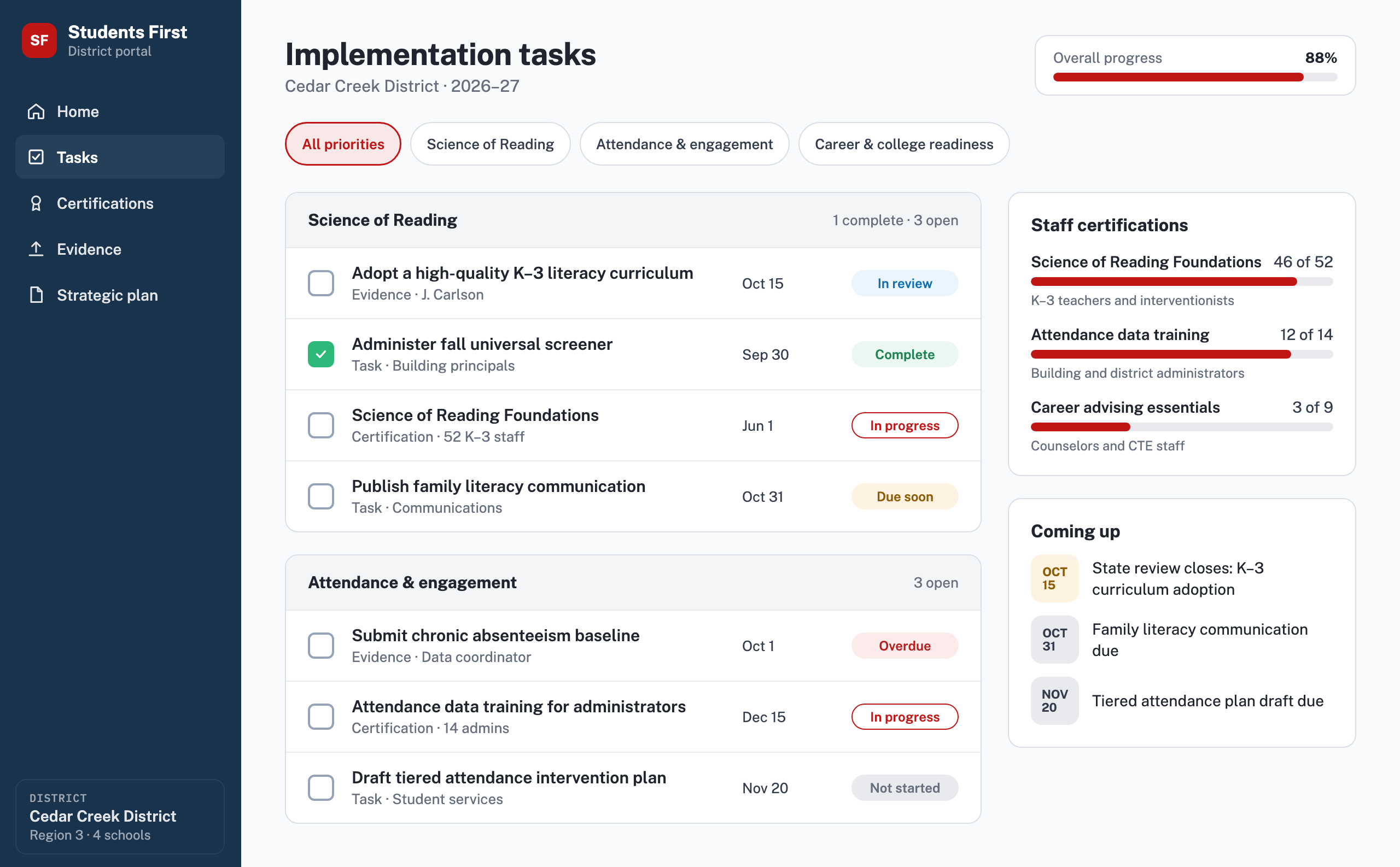
Each district gets that work as a list, grouped by priority, with an owner and a due date for every item. Staff complete their certifications much like coursework in a learning management system, and the district can see what’s overdue and what’s coming up.
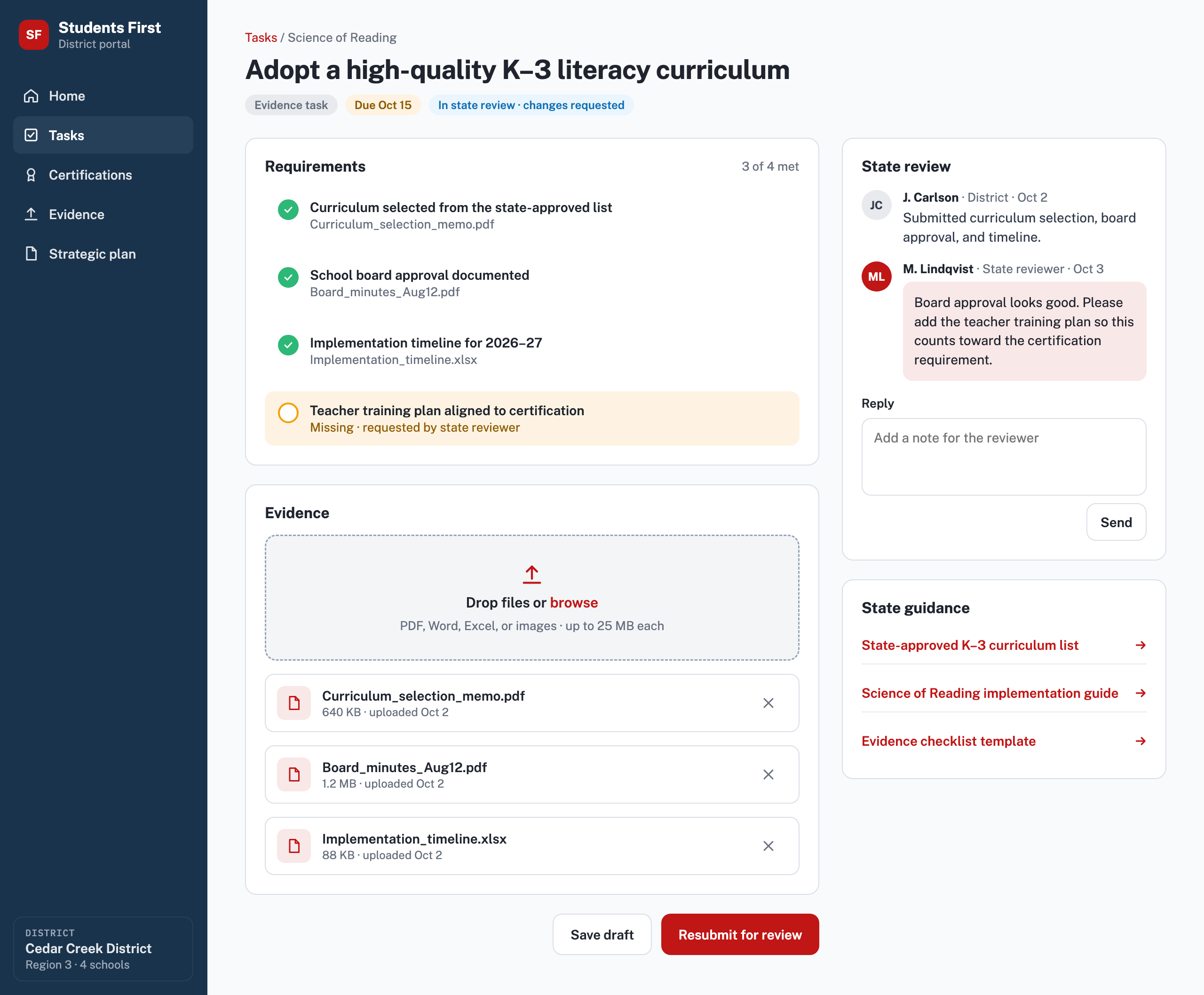
Some tasks need evidence, such as a curriculum memo, board minutes or an implementation timeline. The district uploads files against each requirement and submits the task to the state.
A task doesn’t count until a state reviewer accepts it. The reviewer can ask for changes in a thread on the task, and the district resubmits. That review is what turns each district’s work into compliance data the state can rely on.
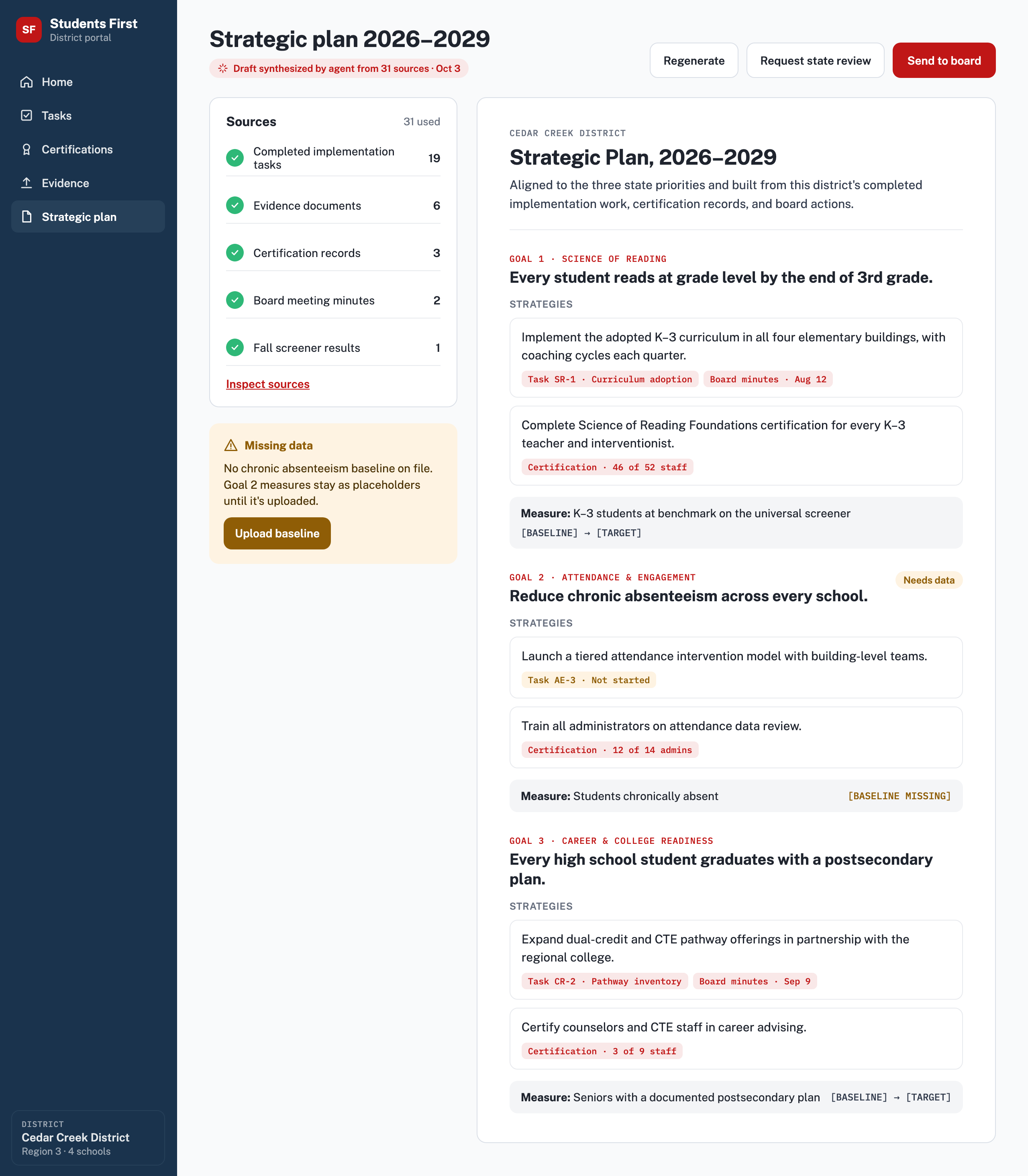
The agent turns that data into a strategic plan. It reads the district’s completed tasks, evidence, certification records, board minutes and screening results, and drafts a plan with a goal for each state priority. Every strategy cites the records behind it. When data is missing, like a chronic absenteeism baseline, the agent leaves the measure as a placeholder and says so instead of inventing a number.
Each district’s plan status shows up in the state’s overview next to its tasks and certifications, so the state sees both the work and the plan it adds up to.
What I built
I was North Dakota’s sole technical advisor from discovery through go-live, and the only engineer on the platform.
- Task and certification tracking for rolling state priorities out to districts.
- An agent that synthesizes district compliance data into strategic plans.
- Evaluation harnesses, guardrails, and observability so a public-sector customer could trust autonomous agents in production.
Students First is a TanStack Start app running on AWS Lambda, with CloudFront in front of it and Postgres behind it. Inference for the agent runs on AWS Bedrock.
Going live statewide
North Dakota went from kickoff to statewide go-live in about a month, covering the state school board and every district in the state.
Most of that month went into the process around the software. We met with the key stakeholders at the state and planned a regimented schedule for checking in on program tasks and compliance. We designed the user roles around how that information is reported, from the districts up to the state. Then we taught users and administrators how to work within their roles in the product.
The part that nearly went wrong was explaining multi-tenancy and anonymity. Both are decided at the architecture level, and the details aren’t easy to follow if you aren’t technical, but the people deciding whether to trust the platform still needed to understand them. Getting there meant abstracting the technical details into terms that made sense to them.
Trusting agents in the public sector
Evals run in CI, and passing them is part of what makes a release ready. They test the agent’s core capabilities, including that it doesn’t hallucinate and that anonymity holds. If a change makes any of them regress, the build fails and the change doesn’t ship. The state never has to be the one to catch it.
Outcome
It’s too early for measured results: North Dakota is still in its first cycle on the platform. But hundreds of educators and state administrators already rely on it day to day to carry out the goals the public has trusted them with.